




Profile
The Spirit of Renewal
Hurricane Melissa was another chapter in a long history of resilience in Jamaica, one that once again called the Half Moon community to come together and begin the work of recovery.
By LAURA REDPATH
PORTRAITS BY KYLE MACPHERSON
Water Poured Through the Stairwells Faster than He Could Push it Back.
He mopped for hours.
Roof drains clogged with leaves and branches forced the rain inside. It slid beneath doors and through window seals. Outside, the wind leaned a high-pitched scream, rattling zinc sheets and tearing through trees with sudden, violent force.
By the time the zinc sheets began lifting into the air, Tendulkar Yuan knew this storm was different.
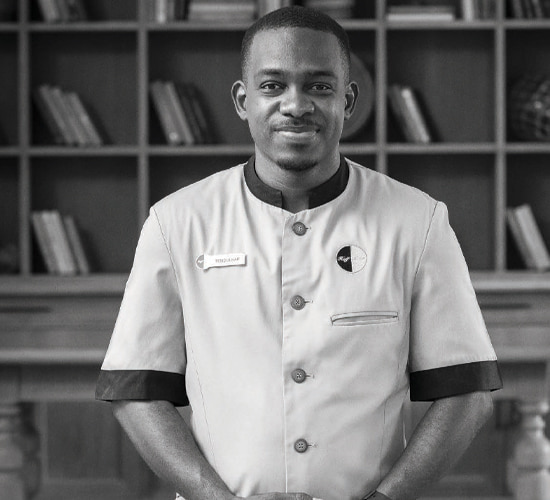
At Half Moon, he is known for welcoming guests at the Bell Desk, greeting arrivals with quiet ease. In the days before Hurricane Melissa, he was preparing for a far more ominous arrival as the storm drew nearer.
Floodwaters rose and debris tore through the air. He watched the place he called home begin to give way. Furniture was lost. Clothing disappeared. His car was damaged.
Yet when Yuan spoke of the storm, he began not with loss but with gratitude.
“I am happy I am still here,” he said simply. “I am happy I am alive.”
Storms are never remembered only by wind speeds or satellite images, but by the lives they change. To understand how Jamaicans felt as Hurricane Melissa approached, one must return to another night.
"I am happy I am still here, I am happy I am alive."
With hearts suspended somewhere between awe and dread, the eyes of Jamaica lifted toward the violent sheet of white that cloaked the Land of Wood and Water. For a people who look to the Blue Mountains and the deep valleys of Cockpit Country and feel protected, secure in the knowledge of the land's history and the resilience of its people, this sheet of white was no gentle covering.
It carried instead the suffocating weight of a scared nation. Scared of the present. Scared of what the future might hold.
The fear coursed through the island, leaving no time to process, as families rushed to secure what was left of zinc roofs and push water back out through their doors.
Hurricane Gilbert churned across the island in the middle of the night as a Category 3, striking Jamaica with a force that left scars and a collective memory that endures to this day.
In the aftermath, Jamaican musician Lloyd Lovindeer captured the experience in a way only Jamaicans could, through humor sharpened by hardship. With pen in hand, he wrote the now legendary lyrics that return to Jamaican lips each hurricane season.
Wa-wa-wa Wild Gilbert
Water come inna mi room bub hub
Mi sweep out some wid mi broom
Di likkle dog laugh to see suh fun
And di dish run away with the spoon.
The lyrics, speaking of a roof migrating without a visa and a satellite dish lifting off like a flying saucer (it was the 80's, after all), still bring tears of laughter to many Jamaicans. It is distinctly Jamaican to transform trauma instinctively into humor, and the song does exactly that: a culturally familiar retelling of disaster, recounted through waves of side-splitting laughter.
Yet beneath the humor was a reality few could forget.
According to the Jamaica Information Service, 45 people lost their lives because of Hurricane Gilbert. One hundred thousand homes were destroyed, and nearly 800,000 Jamaicans sought shelter as the storm passed over the island. The agricultural sector was among the hardest hit, and the World Bank estimated total damage at between US$800 million and US$1.2 billion, a staggering sum for a country whose gross domestic product stood at approximately US$2.9 billion at the time. Subsequent media reports have placed the cost even higher, in the billions. More than 90 percent of public health facilities were severely damaged. Recovery was long and painful, and the hardship profound.
For Jamaicans — from the Silent Generation to the earliest Millennials — the memory of Gilbert lingers. It was the worst natural disaster to strike the island in 37 years, since Hurricane Charlie (1951).
So, when meteorologist Brian Shields appeared 37 years later to speak of another storm — Melissa — the nation held its breath.
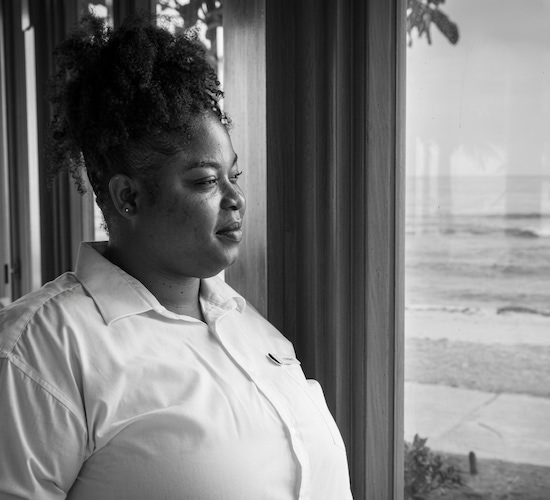
"Half Moon reached out to check on us, and that alone lifted my spirts, I am grateful that the company is supporting us, even when things are so hard for everyone. It shows that we are part of a family."
Time dragged on as the country waited. Place held its breath. With every weather update came another delay, another shift in track, another long night bracing for what would become one of the most devastating days in Jamaica's modern history.
In the time it took for Melissa to pause, shift course, and gather strength, Jamaicans did what they have always done. They turned to humor. Memes spread quickly across phones and social feeds. Content creators fired off hurricane-themed videos that sparked bursts of laughter in the uneasy calm before the storm.
At the same time, preparations were underway. Trees were pruned. Sandbags were dragged in front of doors. At Half Moon, emergency management protocols moved swiftly into place, with morning and evening briefings guiding the team as they secured life and property. Calls were issued for residents in low-lying flood plains to evacuate.
Yet, there were also those who could not leave. Others stayed behind, unwilling to abandon their homes and belongings. Those who prayed for divine intervention while watching the trumpet trees closely, dreading the moment when the pale underside of their leaves would turn upward, a quiet signal known for generations that the storm was coming.
When the trumpet tree turn up, hurricane soon come.
As hurricane models contradicted one another, lively debates unfolded among those watching the storm closely. But by October 28, 2025, speculation gave way to certainty as Hurricane Melissa made landfall near New Hope, Westmoreland. The screeching howls of the Category 5 storm as it crossed Jamaica, with sustained winds of 185 miles per hour and gusts exceeding 250 miles per hour, became the soundtrack for Jamaicans who endured a storm that will be remembered for generations. The National Hurricane Center later confirmed that the storm’s intensity tied with Hurricane Allen in 1980 for the strongest winds ever recorded in the Atlantic basin.
As the storm moved northward, its force shifted from landscape into lives.
At Half Moon, that reality took shape in the experiences of the people who have long defined the spirit of the 72-year-old resort.
A server who fled her home in the middle of the night with her young daughter. A bellman who stood in floodwaters trying to hold his home together. A member of the laundry team whose small farm, built over years of effort, disappeared in a single storm.
Their stories are different, yet they share the same thread. Quiet resilience.
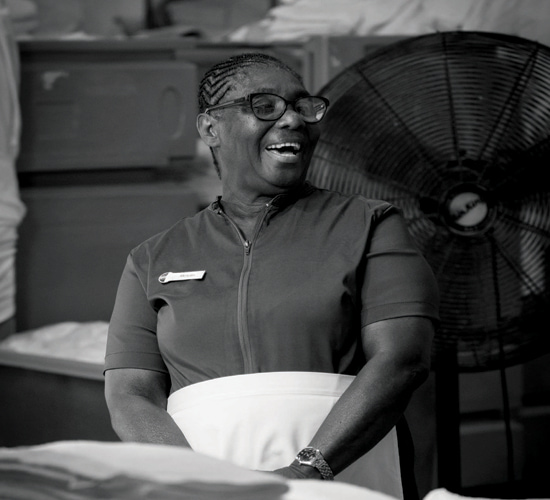
"I am very grateful, working at Half Moon, I've built my house and built the coop and have done whatever I've had to do, and I am very grateful."
Half Moon has weathered its share of storms. Hurricanes, fires, and floods have all tested the resilience of this storied property. Each time, the resort has rebuilt with care and determination, guided by the people who bring it to life every day. Hurricane Melissa was another chapter in that long history of resilience, one that once again called the Half Moon community to come together and begin the work of recovery.
A few days after the storm, Yuan moved across the property with a camera in hand. The Bell Desk had given him a front-row view of arrivals and departures for years. Now he found himself documenting a different kind of journey.
He photographed the hands lifting debris. The feet steadying uncertain ground. The faces marked by exhaustion and resolve. In the aftermath of Melissa, he became a quiet witness to recovery, capturing the small acts of care that would slowly restore the rhythm of the resort.
Among those returning to the property in the days that followed was Moesha Brown.
“Good day,” she began softly. “I am twenty-five years old, and I work at Half Moon as a server.”
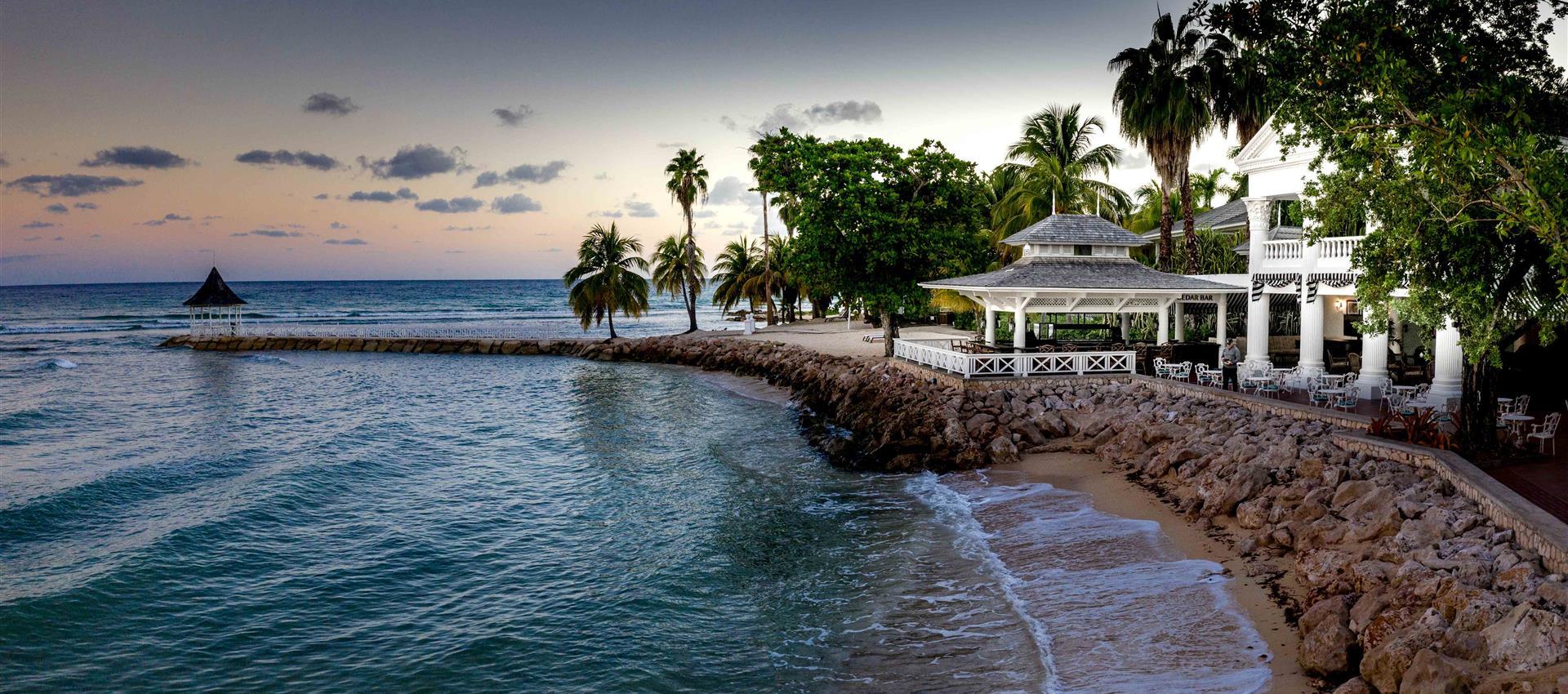
To speak of a smile that lifts the corners of your lips to meet the corners of your eyes is to speak of Brown. A few days after the storm, as the Half Moon leadership team made contact with staff for well-being checks, her familiar warmth softened into something quieter. She sat in the lobby, looking out toward the sloping lawn of Eclipse at Half Moon, the resort’s newest oceanfront experience, and the sweep of the Caribbean Sea beyond, her expression thoughtful and distant.
As she spoke, her memories moved like the tide, rising, receding, and returning.
“I live in the Rose Hall community with my daughter,” she continued with a slow inhale. “When Hurricane Melissa came, everything happened so fast. The wind started to pull at the roof and water began coming inside. I tried to secure what I could, but the roof eventually lifted off and the whole house flooded. My daughter was frightened, and we had to leave in the middle of the night because it was not safe to remain there.”
When she returned home the next day, the reality settled upon her. Most of her possessions were gone. School supplies. Clothing. Furniture. The everyday items that hold a family together.
“You don’t realize how much you have until you see it all destroyed.”
For the first few days, uncertainty lingered.
“But Half Moon reached out to check on us, and that alone lifted my spirits,” she said. “I am grateful that the company is supporting us, even when things are so hard for everyone. It shows that we are part of a family."
There it was. Her smile.
It is not simply something she wears. It is something she carries from within, a quiet radiance that refuses to dim, even in the face of loss.
Brown’s story belongs to the day the storm arrived. Across Jamaica, however, its aftermath revealed itself in other ways.
Amalga Gayle-Smith sat with her hands clasped and her back straight, speaking quietly about the days after Hurricane Melissa.
For Gayle-Smith, a long-time member of Half Moon’s Laundry Department who also operates a small chicken-farming business she has carefully built over time, the impact was deeply personal.
“I had a 20' by 30' coop that raises chickens,” she explained. “It could raise 500 chickens. But at the time I had 75. I lost all of them. Everything came apart, blown right down.”
Small backyard farming operations form the backbone of many Jamaican households, providing income, stability, and food security. The Ministry of Agriculture reported that more than one million birds within the poultry sector were lost. Hurricane Melissa destroyed coops and disrupted feed supplies, dealing a painful blow to livelihoods already vulnerable to the pressures of a changing climate.
Across Jamaica, stories like Gayle-Smith’s are common.
Yet even as she described her losses, her expression softened when she spoke about her twenty-two years at Half Moon.
“I am very grateful,” she said. “Working at Half Moon, I've built my house and built the coop and have done whatever I've had to do, and I am very grateful.”

"Our priority was helping our staff secure their belongings, stabilize their homes, and begin getting back on their feet. That was important to us; it was our mission. Because recovery is rarely defined only by what is lost. It is revealed in what rises again."
At least 45 Jamaicans died as a result of Hurricane Melissa. The Planning Institute of Jamaica (PIOJ) estimated that the damage caused by Hurricane Melissa was four times that of Hurricane Gilbert, totaling approximately US $12.2 billion — an amount equivalent to nearly 56.7 percent of Jamaica’s gross domestic product in 2024. The social sector, encompassing population, education, health, housing, and culture, suffered the greatest impact.
Beyond the statistics, however, lies the loss of places that form part of Jamaica’s cultural and historical fabric. In Black River, St. Elizabeth, one of the island’s earliest modernized towns and the first to receive electricity in 1893, entire sections of the historic district were left deeply devastated. Landmarks such as the Beeston Spring Moravian Church, one of Westmoreland’s oldest religious sites, were destroyed alongside century-old buildings that had stood for generations.
Amid the devastation, the Half Moon community (nearly 900 team members and partners) came together with determination to recover and rebuild. With the support of guest and partner donations, the resort raised just over US$500,000 to fund care packages and support home rebuilding efforts for staff.
“We stayed closed and focused on thoughtfully supporting our staff,” said Managing Director, Shernette Crichton. “Our priority was helping them secure their belongings, stabilize their homes, and begin getting back on their feet while the country undertook the wider recovery effort. That was important to us; it was our mission. Because recovery is rarely defined only by what is lost. It is revealed in what rises again.”
Like Gilbert before it, the World Meteorological Organization (WMO) has since retired the name “Melissa.” Across Jamaica, homes are being repaired, livelihoods restored, and communities slowly returning to rhythm. At Half Moon, that spirit of renewal found its most powerful expression in something both simple and profound.
A tree.
But not just any tree.
The guango tree. Known for its wide canopy, generous shade, and deep cultural symbolism, its name traces back to the language of Jamaica’s indigenous Taino people. Also known as the rain tree, it stands at the centre of Eclipse at Half Moon, a quiet and familiar presence within the landscape.
During Hurricane Melissa, the guango tree was uprooted by the storm. In the days that followed, the landscaping team carefully set it upright and replanted it.Its canopy was gone, stripped bare by the storm, much like the hillsides of western Jamaica. But slowly, almost quietly, new leaves began to appear.
As the tree began to recover, it became a quiet marker of time alongside the broader recovery at Half Moon. While teams cleared debris, restored spaces, and prepared to welcome guests once again, the guango stood nearby, returning to life in its own way.
A living reminder of what the storm could not take away. Resilience. Endurance. The quiet certainty that life begins again.
As the Jamaican saying goes:
Nuh matter how breeze blow, tree baffi stan' firm.
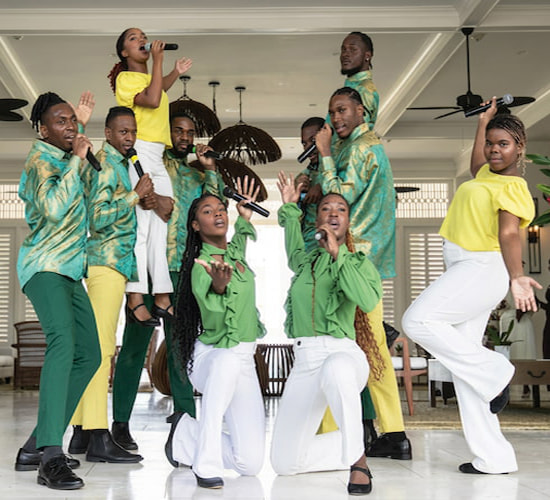
Rising from the Ashes: Half Moon, Jamaica's highest-rated property, welcomes back guests following post hurricane restoration
Half Moon, one of the Caribbean’s most storied destinations, reopened its luxury hotel Eclipse, marking a momentous milestone in Jamaica’s tourism recovery following the passage of Hurricane Melissa in October 2025.
The vibrant reopening featured a special and unique ceremony, bringing together government officials, tourism leaders, community partners, and hundreds of members from the Half Moon team to mark the resort’s return and celebrate the resilience of the island’s hospitality sector.
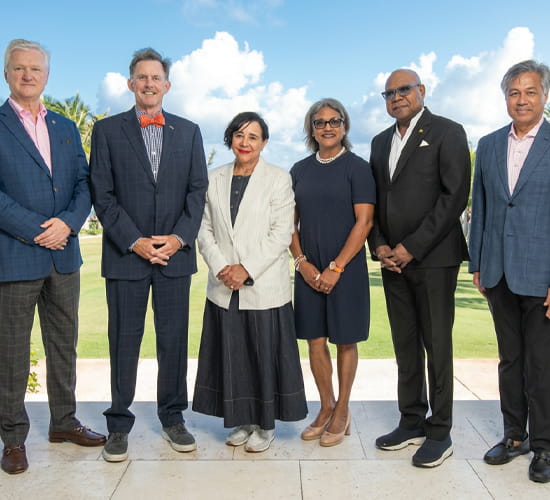
Sheila Johnson and Team
In lieu of a traditional ribbon cutting, artistic performers Ashe created a dance move to signify a phoenix rising from the ashes, while, to conclude, dignitaries flipped convention on its head and applauded the staff and accompanying band into the hotel first as a sign of respect.
Dignitaries in attendance included Edmund Bartlett, Jamaican Minister of Tourism; Guy Steuart III, Chairman of Half Moon; and Sheila Johnson, Founder and CEO of Salamander Collection.
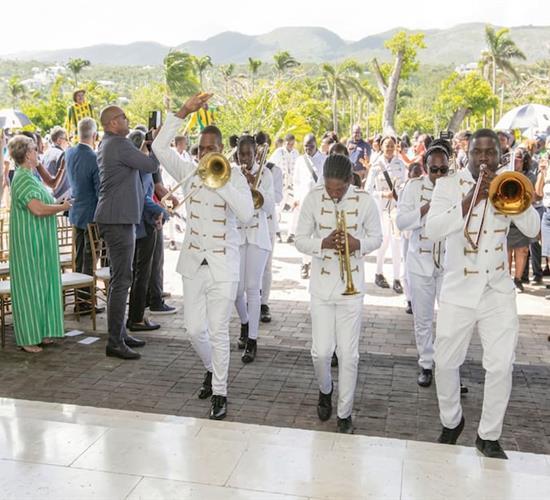
Marching Band Celebration
Throughout the remarks, Half Moon team members were lauded for their resilience and hard work, especially Resort Managing Director Shernette Crichton, who was promoted the previous day during an emotional all-staff meeting.
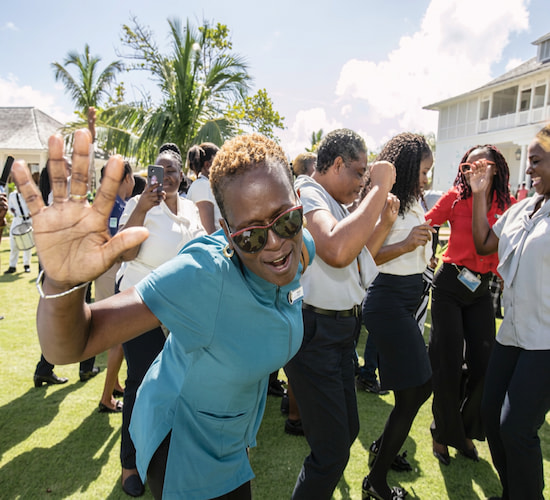
Rising From The Ashes: Dancing
“Hurricane Melissa came through Western Jamaica like a thief in broad daylight and took things from us that we never imagined we could lose,” said Crichton. “But look around today – every team member here is proof that Melissa did not get the last word. And now we are fortunate to get the opportunity to do what we do best – deliver authentic Jamaican service with a smile. Half Moon is back!”
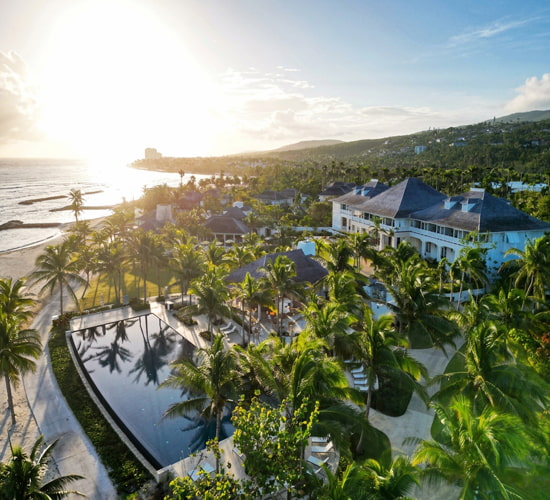
Welcome Back Home to Half Moon Offer
Half Moon invites guests to linger longer with a complimentary fourth night when reserving three. Additionally, the package features:
- Luxurious accommodations at Eclipse at Half Moon
- Daily breakfast at the seaside restaurant, Hayward’s
- Children five and under dine complimentary throughout the entire stay
- Offer valid for stays through December 19, 2026, with reservations made by December 14, 2026.
- Blackout dates may apply.
To make a reservation, visit HalfMoon.com, e-mail [email protected] or call +1 (800) 626 0592.
Contact Us
For advertising inquiries, please contact [email protected]