




PROFILE
Play Smarter Not Harder
By Terence Loose
Three Keys to Improve Your Shot Making and Lower Your Score

Golf is deceptively complicated.
There are hazards and obstacles, of course, but there are also uneven lies, varying ground conditions, wind — not to mention the nuances of your swing. Think too much about keeping your head down, your elbow in and your shoulders rotating too much and, as they say, a day on the links can turn into just another good walk spoiled.
The key to turning your round into a wonderful day — with fewer shots fired — is to keep it simple, have a plan, and swing with confidence, says Dawn Mercer, Director of Instruction at Innisbrook Resort, home of the PGA TOUR's Valspar Championship. As a decades-long PGA Class A member who wrote the "Efficient Golf Instruction Manual" and co-authored the book "Putt for Dough," Mercer has helped golfers of all levels enjoy their "walks" for 35 years.
Her philosophy is to harness the player's natural instincts, integrate mental strategies and visualize success to achieve peak performance. To that end, she has three keys to help you improve your shots, lower your score and have more fun.
DAWN MERCER,
DIRECTOR OF INSTRUCTION
AT INNISBROOK RESORT
With over 35 years of teaching experience at Innisbrook, Mercer is one of only a handful of female instructors at PGA TOUR venues. Named one of the country's Top 50 Female Instructors by Golf for Women magazine, she conducts the highly recognized and successful Innisbrook Golf Institute.
Three Tips
1 HAVE A PLAN
Too often, golfers hit the links without first studying the course and the types of lies, hazards and conditions they may encounter. It's important to understand the course, how it's laid out, and how your particular strengths and weaknesses fit it — or don't. The point is, you need to both mentally and physically prepare for the specific course you're about to play.
2 APPLY PHYSICS
This is where you choose the best club selection and set-up for the shot in front of you, while always planning for the shot after that. This takes a solid understanding of the hole, the lie, the conditions, and your abilities. For instance, if the fairways are narrow, the wind is up and you have a tendency to spray your driver, leave your ego — and your driver — in the bag. Are long irons your weakness? Consider laying up on those long holes. Better to be short and in the fairway than long and in the woods.
3 TRUST AND GO!
This is the most important part of your plan for a low scoring round. "Once you've committed to a shot, let it go!" says Mercer. The fact is, if you're tentative, or try to guide your shot, your swing disintegrates, your clubhead slows instead of accelerates through the ball, and you get less, not more, accurate. And the worst part? It snowballs, because a bad shot shakes your confidence even further. So, trust in your preparation!

The Plan in Action
Let's take a look at applying Mercer's "play smarter, not harder" approach to two of the more challenging holes at the Innisbrook Resort and Golf Club courses, including how to play different lies and situations.
Island Course #12 Par 4 399 White yardage / 375 Red yardage
This dogleg left starts uphill, then finishes downhill to the green. To score well here, says Mercer, the best tee shot is center to right of center in the fairway with a distance that gets you to level ground, around the 150 marker or beyond.
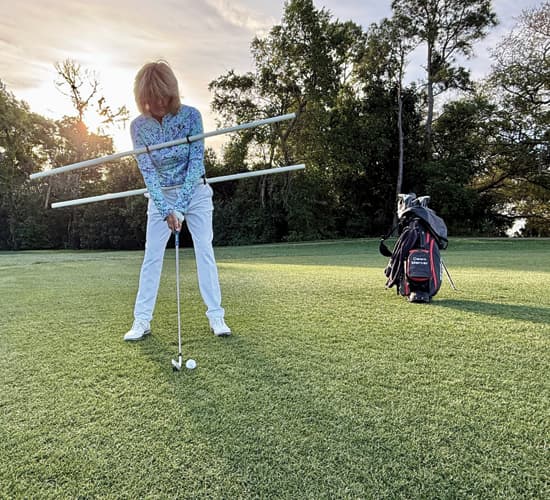
Playing an Uphill Lie: There's a good chance you'll have an uphill lie for your second shot on this hole. Here's how to play it. First, select a longer, less lofted club for overall distance. Make sure your body is parallel to the ground and play the ball towards your higher foot as that's where the club will strike the ground. "Next, make sure to aim right to counter the ball curving left for a right-handed golfer, or aim left for a left-handed golfer," Mercer says. Finally, accelerate your swing through the ball to a high finish to support the stability of your body since gravity will be pulling you back.
Playing a Downhill Lie: If you crushed your driver, congratulations, you made it over the hill and now are "rewarded" with a downhill shot to the green. Here's how to attack this. Grab a shorter, more lofted club from your bag. Again, keep your body lines parallel to the ground and play the ball towards your higher foot since this is where the club will strike the ground first. Aim left to counter the ball curving right for a right-handed golfer or aim right for a left-handed golfer. Finally, swing to a low finish to support the stability of the body since gravity will be pulling you down.

The Plan in Action Continued
Copperhead Course #16 Par 4 385 White yardage / 340 Red yardage
This is a slight dogleg right that has water all along the right with a narrow fairway.
"The best tee shot is center to left of center with a distance that gives a clear shot to the green, yet avoids the water," says Mercer. If a driver is too much, it's best to go shorter off the tee. The danger of this hole is the second shot. With average distances off the tee, you can be left with a shot that's blocked left.
Playing a Blocked Shot: On this hole you can easily find yourself in the trees left of the fairway with overhanging branches. To get home, the ball needs to come out low and long. Select a longer, less lofted club so you use a shorter swing but still attain distance. "Play the ball towards your back foot as we want to hit the ball first on a downward blow," advises Mercer. "You want your weight and hands forward, choking down on the grip." Finally, swing with a decelerated, low finish to keep the ball low and running.
Most of all, says Mercer, try to remember your real goal is not to score the lowest number possible, it's to have the most fun. Because the golfer who's enjoying their walk the most is the true champion of the day.
Contact Us
For advertising inquiries, please contact [email protected]