



WE SHARE PRO TIPS
Keeping Score
By TERENCE LOOSE
How to play some of our resorts' most stunning golf holes.

PGA NATIONAL RESORT PALM BEACH GARDENS CHAMPION COURSE 18
The premier Champion 18, Par 5 dogleg-left "has a generous fairway off the tee," says Randy Raimondi Jr., head golf professional at PGA National Resort in Palm Beach Gardens, FL. "With severe narrowing for the lay-up shot," he adds. Players should know the approach to the green "has bailout left off the green, but is made difficult with water right and bunkers left."
AVOID AT ALL COSTS: "Beware the right pin as that portion of the green only has a sliver of green to work with," says Raimondi, Jr.
PAR 5 | WHITE TEE YARDAGE: 506 | HANDICAP: 10
PGA PALM BEACH GARDENS MATCH COURSE NATIONAL RESORT 17
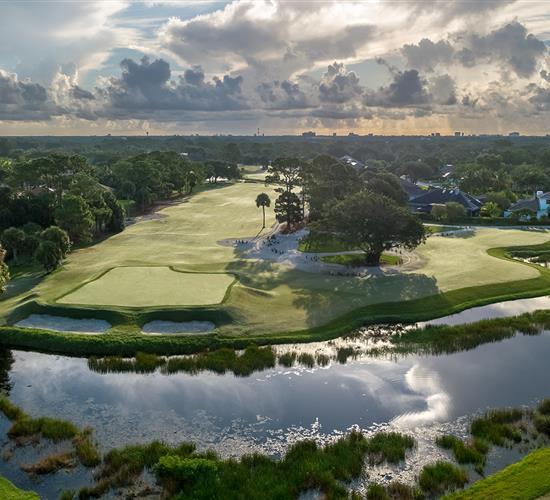
Match 17 is a bit tighter than it looks, according to Raimondi, Jr., with out of bounds bordering each side. "I would keep the driver in the bag to ensure you hit the fairway and split the 'twins' hazard, sand bunker on the left and grassy hollows to the right," he says.
AVOID AT ALL COSTS: This two-tiered green runs from front to back and can be quick, "so be sure to stay below the flag and not go long, as two challenging bunkers surround the back of the green. This is a hole to be happy with a 4 and move on," he says.
NO PAR | WHITE TEE YARDAGE: 396 | NO HANDICAPS

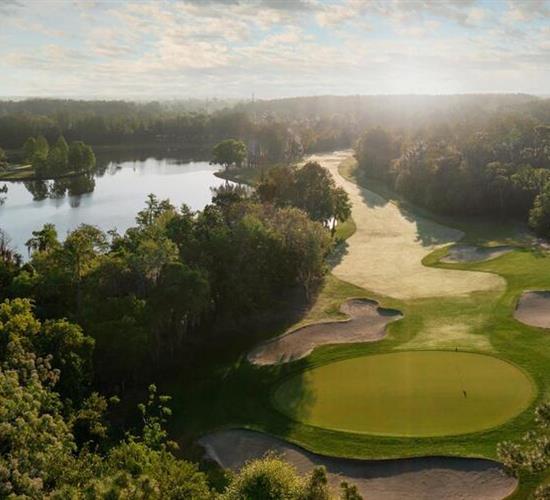
INNISBROOK SALAMANDER COLLECTION ISLAND COURSE 3
The key to surviving this dogleg right is keeping the ball down the right side and avoiding the trees to the left, said Andrew Corry, director of golf at Innisbrook in Tampa Bay, Florida. So, if you can hit a slight fade, you're golden. From there, on your approach, you want to avoid the bunkers to the left and right, and the back of the green, which is very large and undulating. "So, if you're going to miss the green, miss it front middle," says Corry. "If you go long, it slopes back to front and will leave you with a tough up and down."
AVOID AT ALL COSTS: "You want to avoid the left side of this hole, because of the trees that come into play on your approach shot. And for the average golfer, they're probably not going to be able to hit it high enough to get over the trees to make the green," says Corry.
PAR 4 | WHITE TEE YARDAGE: 396 | HANDICAP: 3
INNISBROOK SALAMANDER COLLECTION ISLAND COURSE 7
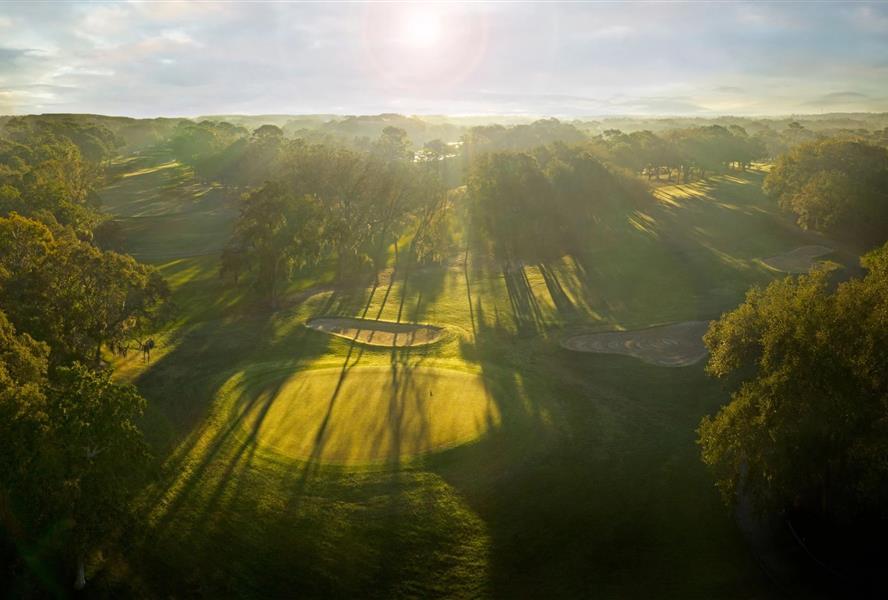
This double dogleg par five is, in Corry's opinion, the most challenging hole at Innisbrook. Why? "You've got a very challenging tee shot with trees on the left and the right, and if you hit it too far, you hit it into the lake," says Corry. But that's not what makes this hole so tough, he says. "What usually makes a par five challenging is the tee shot. What makes this more challenging is not only do you have a challenging tee shot, but you have a challenging second shot." The trees continue down the left, with water down the right, and since it's a par five, if you get in trouble, here, you can post a huge number.
AVOID AT ALL COSTS: Missing the fairway on the tee shot. Lose it right and you're in the water, but lose it left and fail to cover the corner, and you're in the trees without a clear second shot. And you're still a mile away from the green.
PAR 5 | WHITE TEE YARDAGE: 510 | HANDICAP: 1
INNISBROOK SALAMANDER COLLECTION NORTH COURSE 5
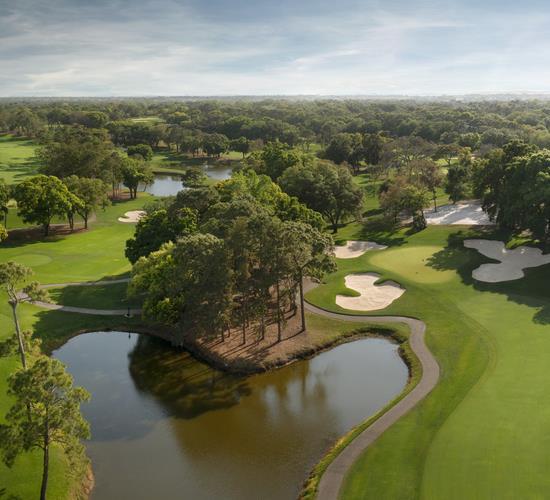
There's nothing like an island green to increase both the beauty of a hole and the heart rate of the golfer playing it. That said, this short par four is not as challenging as it looks. Yes, there is a lot of water, all down the right side of the fairway and surrounding the green. "So your goal here is to get the tee shot in the fairway, probably with a hybrid," says Corry. That way you have a better chance of avoiding intimidation by the island green on your approach. "Because," he says, "the green is actually very big, with a bailout area."
AVOID AT ALL COSTS: Missing the fairway off the tee and allowing all the
water and the island green to get in your head. And if you do get in trouble, remember, you have a big green and a bailout area between the palm and the bunker. So miss short on the approach if anything. The last thing you want is a bunker shot with water behind the green; that's a recipe for two, or more, bunker shots.
PAR 4 | WHITE TEE YARDAGE: 325 | HANDICAP: 5
INNISBROOK SALAMANDER COLLECTION COPPERHEAD COURSE 3
Copperhead, the PGA TOUR's 7th toughest course, is infamous for its three finishing holes, appropriately named The Snake Pit thanks to their individual names: Moccasin, Rattler, and Copperhead. But Corry says he actually believes holes two, three and four are just as challenging. For starters, this dogleg right has water all down the right side, not good for the faders and slicers. This hole is not overly long, so Corry suggests leaving the driver in the bag on the tee. Hit a hybrid or a three-wood and stay dry and in the fairway. "You are leaving yourself with a slightly longer shot into the green, but you're giving yourself a chance," he says.
AVOID AT ALL COSTS: For the average golfer, it's about modesty. Do not get too ambitious off the tee and avoid the water on the right off the tee and the water and the bunkers on the approach shot. In other words, placement, more than length, is everything here.
PAR 4 | WHITE TEE YARDAGE: 386 | HANDICAP: 7
HALF MOON MONTEGO BAY JAMAICA HALF MOON 2
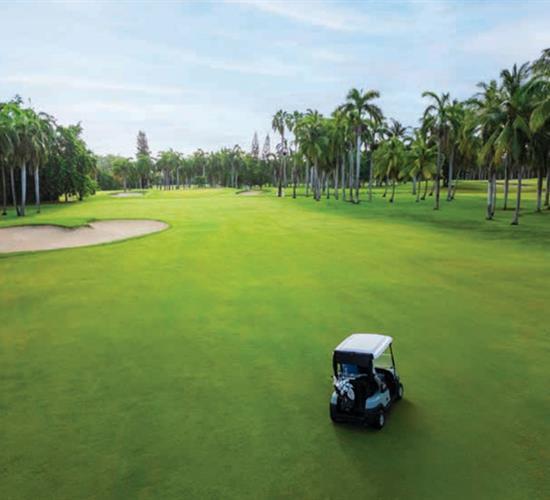
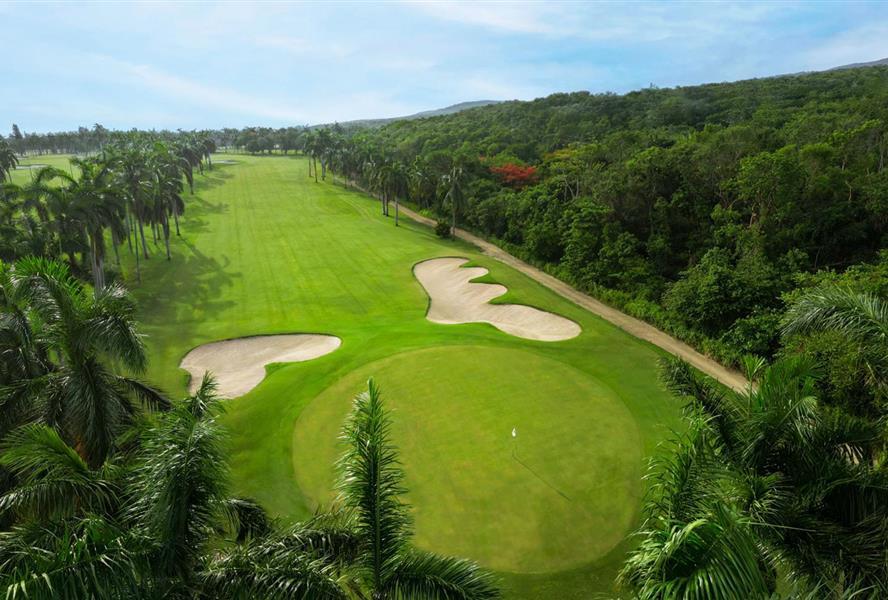
This hole has a prevailing headwind, along with a slightly uphill fairway, so it can be easy to get deceived and under club, says Kevyn Cunningham, director of golf at Half Moon Golf Course in Montego Bay, St. James, Jamaica. It's also a narrow fairway landing area, so Cunningham says you'll want to make sure you have confidence in your club selection. "A good drive will leave you with a medium-to-short iron to a green with a gully in the front of it," he says. So, just as on the drive, make sure of your club selection on your approach shot. "The front quarter of the green is a false front, so you've got to make sure you reach the top of the green."
AVOID AT ALL COSTS: "What you want to try to avoid is under-clubbing on the second shot into the green because of the gully," says Cunningham. That starts off on the tee, because the palm trees lining the fairway are more trouble than they appear. "The palm trees are a little deceiving," he says, "because they don't look like you're going to get blocked and then you get in them and you have no angles into the green."
PAR 4 | WHITE TEE YARDAGE: 354 | HANDICAP: 5
HALF MOON MONTEGO BAY JAMAICA HALF MOON 8
Success on this slightly downhill dogleg right par five begins and possibly ends with a key decision on the tee. "The decision has to be made on the tee whether you can hit it far enough to get over the green-side bunker," Cunningham says. Carry the bunker, roughly 200 to 235 yards out, depending on the placement of the tees in the tee box and the side of the bunker you carry, and you leave yourself a chance to go for the front of the green on your second shot. "If you don't have that type of distance, then you have to play left of the bunker and play it as a par five," says Cunningham.
AVOID AT ALL COSTS: Two things. The first is landing in that expertly placed fairway bunker off the tee. That will make this hole very long. The second is going long on your final approach shot into the green. "You leave yourself with an uphill pitch and there's not a lot of room behind the green," says Cunningham.
PAR 5 | WHITE TEE YARDAGE: 543/506 | HANDICAP: 15

HALF MOON MONTEGO BAY JAMAICA HALF MOON 7
This short par three usually has a cross wind pushing your shots right to left, which can add a challenge. Add to that the narrow entrance to the green, and you should not let the 17 handicap lower your guard. Cunningham suggests listening to your caddy for club selection - by hole seven, they know how you play, and they are experts here. Then, make sure you hit your yardage on the club, "If you're short, you bring that narrow area into play, and if you're long, it's very difficult to chip back onto the green," says Cunningham.
AVOID AT ALL COSTS: "The thing you've really got to avoid is short-siding yourself around the green, because wherever the flag is, if you short-side yourself, the chip is always going to be difficult," says Cunningham. So, if the flag is to the right, don't miss right. If it's to the left, don't miss left. Easy, right?
PAR 3 | WHITE TEE YARDAGE: 133 | HANDICAP: 17
HALF MOON MONTEGO BAY, JAMAICA HALF MOON FRONT NINE
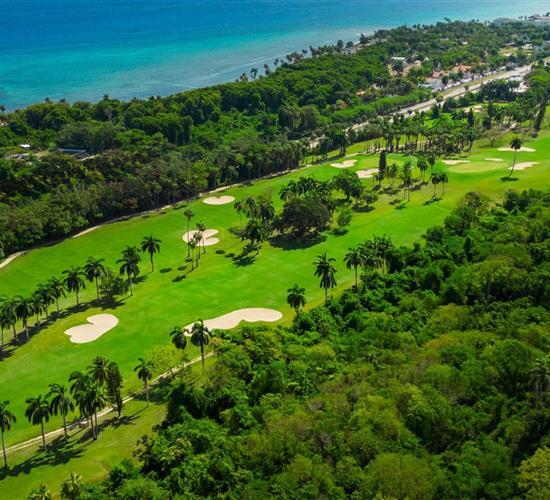
Just as every hole has a strategy, so does the course, especially the front nine. "Remember the first four holes are into the wind here, so I try to start off conservatively and find the rhythm of the round," says Cunningham. "See what the round is giving you, how your body feels, how your swing feels." He suggests aiming for the big parts of the greens, at least until you round the corner and get the wind at your back. "Then you can start to attack a little bit." Most importantly, listen to your caddy. All this is important, he says, because you want to build your confidence for coming home on the back nine. "You've got the final five holes and they are brutal if you're struggling because you've got that strong one to two club wind," he says. If you lack confidence here, it could mean a big number.
AVOID AT ALL COSTS: Putting up a huge. number on the front nine. Don't get too aggressive on the front nine. If you go into the back nine with a big score and no confidence, it'll be a long day. Of course, since you're in Jamaica, a long day outside on the golf course isn't necessarily the worst thing.
PAR 36 | WHITE TEE YARDAGE: 3301/3153
Contact Us
For advertising inquiries, please contact [email protected]