

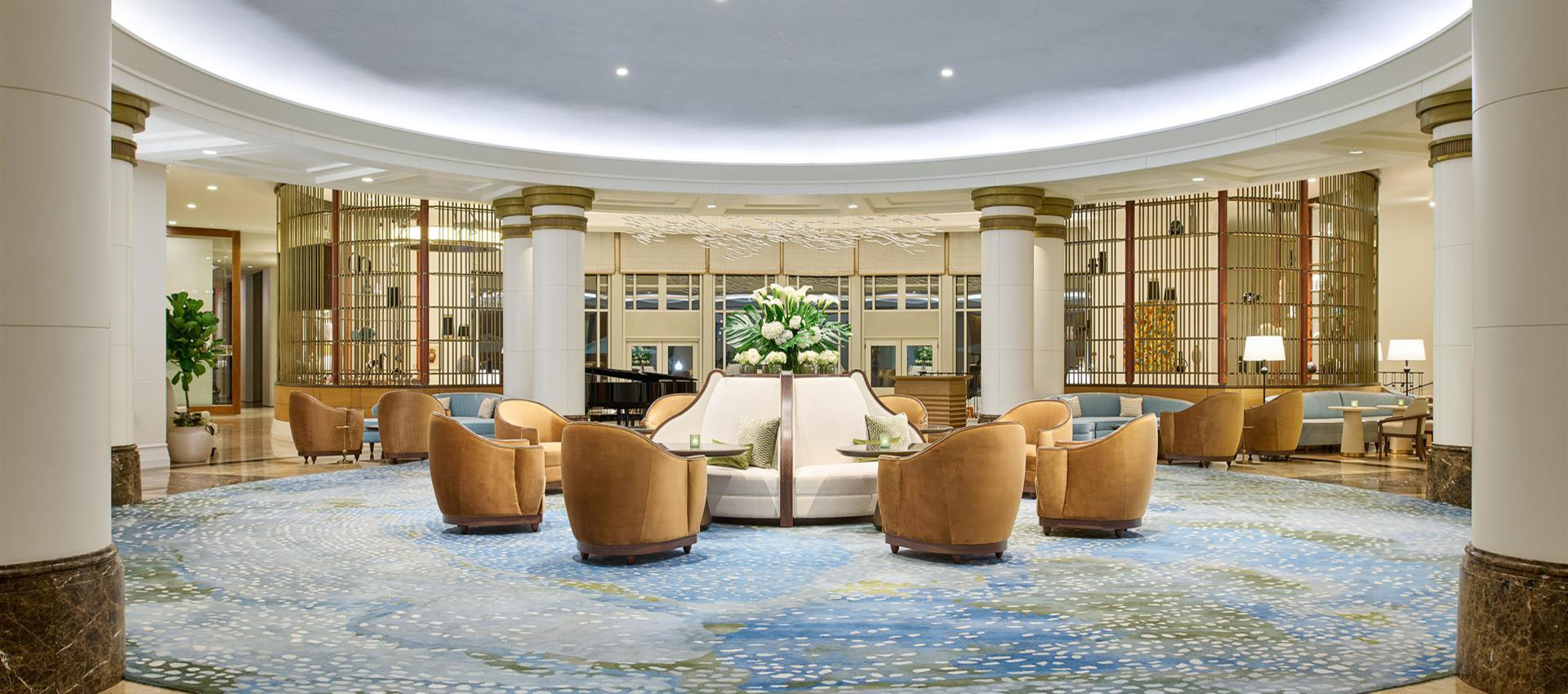
Profile: MICHAEL GLICKMAN
Weighty Art
By TERENCE LOOSE
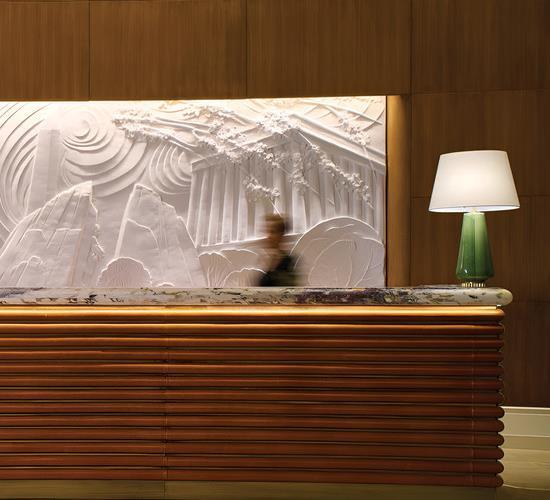
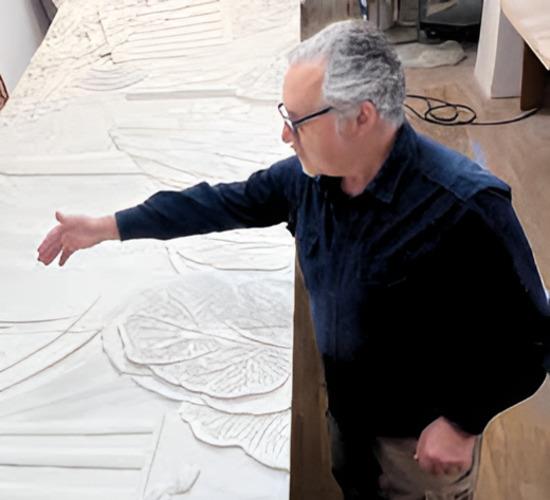
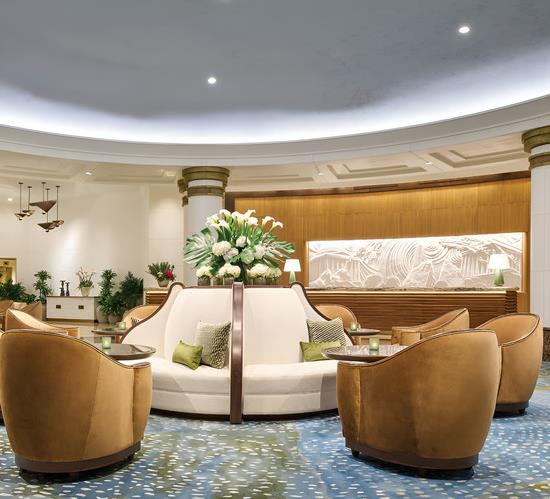
The stunning bas-relief artwork that greets guests at Salamander Washington D.C's front desk is the creation of renowned plaster artist Michael Glickman, Founder and art director of Art Space NYC.
WEIGHTY ART
MICHAEL GLICKMAN Q&A
SALAMANDER MAGAZINE: Although you studied art at the venerable Academy of Design in St. Petersburg, being an artist was not your first career.
MICHAEL GLICKMAN: No. I have a master's degree in both aviation engineering and art and design, so I went from an aviation engineer in my first life to a car racer in my second life to an artist and designer in my third life. I've had many roles in my life, and I've enjoyed every one of them.
SM: What did your path to success in America look like?
MG: When I emigrated from the USSR I spoke no English, so I had to work as a car mechanic in the Bronx for $3.50 per hour. Then, I got a position as an artist's assistant. In both those jobs I never spoke -I was the silent mechanic, the silent assistant. But I worked hard and stayed focused on creating a better life. Later, I became an artist, founder of Art Space NYC, art director, husband, father, and everything in between.
SM: What was the inspiration for the style of the Salamander DC piece?
MG: When we received the request for the proposal to design the artwork, it was clear to me from the beginning that it should be in an art deco style. That's because, in my opinion, the city is the capital of art deco, filled with magnificent monuments of that era.
SM: Is creating art for a client's vision different from expressing your own?
MG: Yes, the challenges are very different. For this piece, for example, we received a wish list from the ownership team. They wanted the bas-relief to reflect the monuments on the national mall, including the Washington Monument, the Lincoln Memorial, the Thomas Jefferson Memorial, and the Martin Luther King Memorial. Additionally, the owners wanted horses to reflect Salamander Founder and CEO Sheila Johnson's integral role in building the new equestrian facility on the National Mall.
Lastly, since cherry blossoms are a very prevalent theme in DC, they thought those would soften the piece.
SM: That's very specific, and diverse. What was your initial reaction?
MG: I said, "What? Really? How is this going to be possible?" But then I pulled myself together and started making sketches. And to be honest, initially it didn't go very well.
SM: What changed?
MG: I decided not to draw every single item from the list, but rather let my hand lead me in energetic, powerful pencil drawing. As I was told by my art teacher, when you draw, you need to be ready to put your head in the guillotine for every single line you make. So, it became not so much about the list of monuments, but rather about a balanced composition, dominances, light and dark, sharp graphics and "the wind in the sky." The final sketch was completed in a thirty-minute session that reflects me as an artist first and the list from the client second. But that is why clients come to me, or any artist for their personal expression of the client's vision.
SM: Can you speak about some of the challenges and how you overcame them?
MG: First, from a technical point of view, the reception wall is curved, so every panel, each of which we created in the New York studio, had to come together like a puzzle on a curved substrate once installed. To ensure it was seamless, I relied on my education in aviation design. I came up with the idea of building a temporary curved platform in my studio on which to assemble all six panels during the initial clay model fabrication, and later the plaster cast. My foreman measured the wall's radius and dimensions on site and we built the curved platform accordingly. And because it is an operational hotel, there was no way the artwork could be done on site because it takes about three months to produce. Thanks to our studio construction approach, we spent only one week on site and avoided a major disruption of business. And during that week, we interacted with guests who were curious about the artwork.
MICHAEL GLICKMAN Q&A CONTINUED
SM: Can you give me a rundown of the steps and time involved in this piece?
MG: It took three months of work in our studio in Chelsea, NYC. After our sketch was approved, it was enlarged to actual size and printed on vinyl and placed on large working tables over six plywood sheets, which imitate actual panels. Then we started sculpting on that with clay. The curved bedding platform had been built, so
next we placed the six plywood sheets with clay bas-relief on the platform to make a curved relief. The last thing we did were the horses. With these, we had some issues.
SM: How so?
MG: Horses are difficult to sculpt.
Galloping horses even more so. In fact, they were sculpted at least three times. Nothing worked. Then I remembered the best horses were sculpted by the ancient Greeks. They became our inspiration for the two horses on the left. As the next step, the pink mold was cast from clay
panels and, eventually, we cast the plaster, reinforced with metal frames for stability.
SM: In your opinion, what makes wall plasters unique or impressive for commercial (or any) spaces?
MG: Mostly, it's about the balanced composition and advantage of 3D objects in angled lighting. The art changes with the different lighting of day and night, magnetizes your attention, and remains in your memory long after you view it. In short, it makes the whole space incredibly special and memorable.
Contact Us
For advertising inquiries, please contact [email protected]